Curbs
Curbs Too Short for a Thicker Roof
When insulation gets added, a short curb leaves too little flashing height, and wind-driven rain gets over the top.

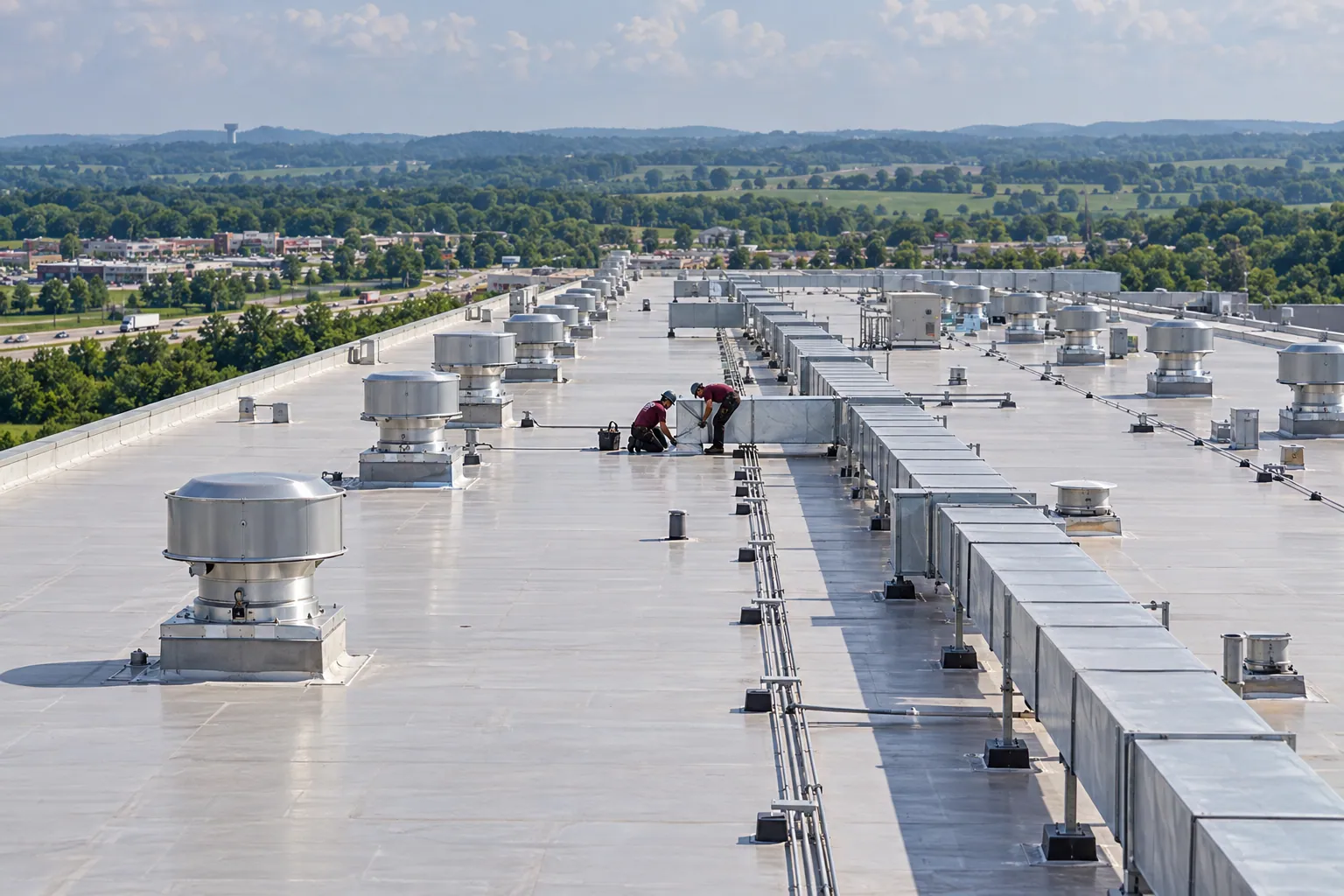
As a Lebanon commercial roofing contractor, we replace and repair roofs crowded with rooftop units, raising curbs and reflashing each one so the new roof stays tight.
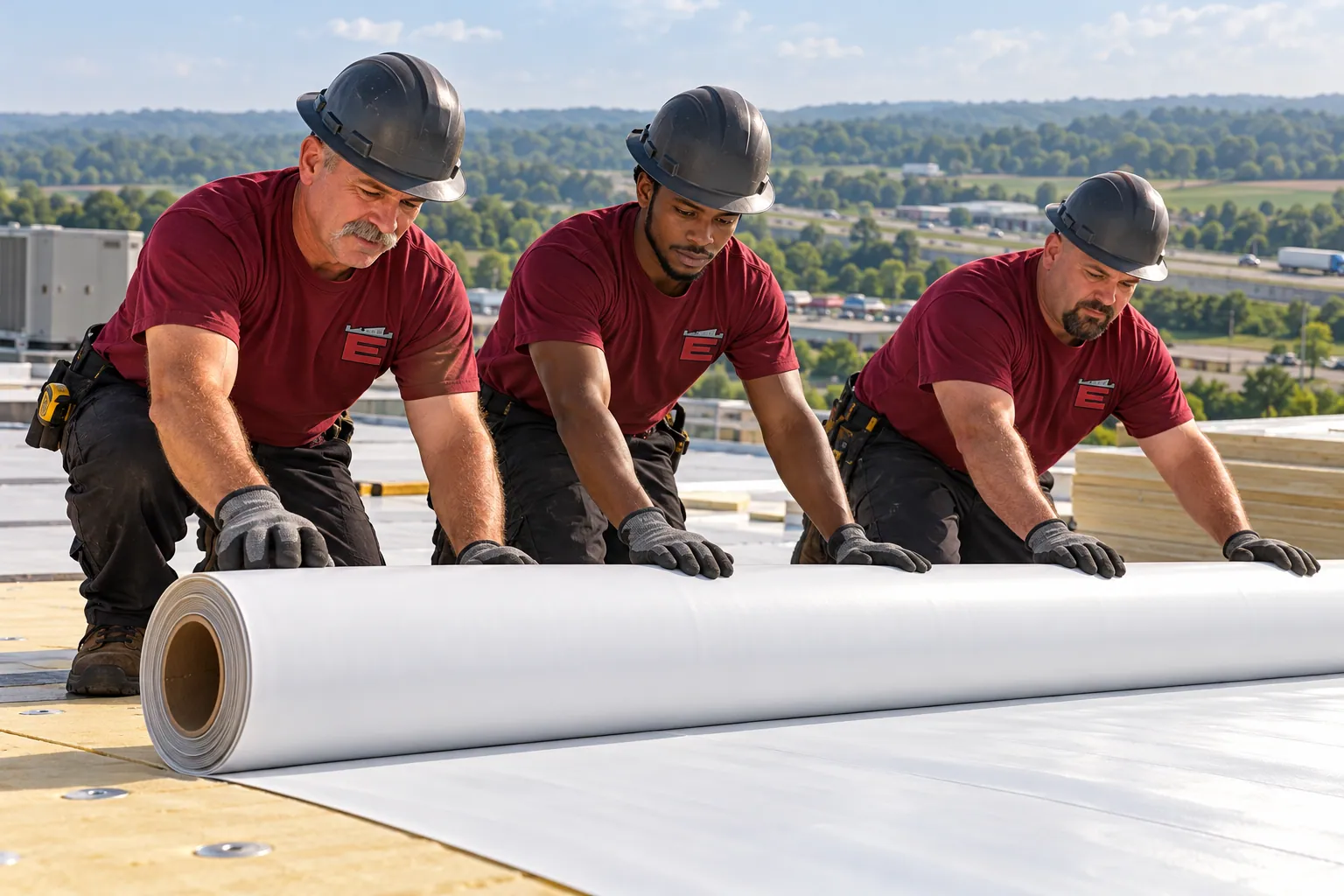
Equipment-heavy roofs are where a Lebanon commercial roofing contractor spends the most detail time. Every rooftop unit, exhaust fan, and duct sits on a curb, and each curb is a flashing joint that has to stay tight while the unit vibrates and the roof moves.
A new roof with thicker insulation raises the surface against those curbs. Units get lifted so curbs can be raised and flashed again, and mechanical contractors are scheduled to disconnect and reconnect them around the roofing crew.
Leaks on equipment-heavy roofs start at one of these four details.
When insulation gets added, a short curb leaves too little flashing height, and wind-driven rain gets over the top.
Vibration and years of sun dry out curb flashing until it cracks at the corners, where water slips under the membrane.
Duct, gas line, and conduit penetrations sealed with pitch pans that have dried and shrunk leak around their edges.
Technicians cross the same paths for every service call, wearing through the sheet where walkway pads were never laid.
Getting the curbs right is most of what a new roof does on a building like this.
Raised curbs leave room for full flashing height above the thicker roof and its new insulation.
Pitch pans are replaced with pre-formed pipe boots where pipes allow, and ducts get new curb flashing.
Leaks over offices and production space stop once the curbs and penetrations around each unit are closed.
Mechanical contractors disconnect and reconnect units on a set schedule, so cooling and heating return as planned.
Walkway pads to each unit keep future service calls from wearing out the new membrane.
Photos of every curb after flashing show the next technician where the roof work ends.
These three services fit roofs carrying many units.
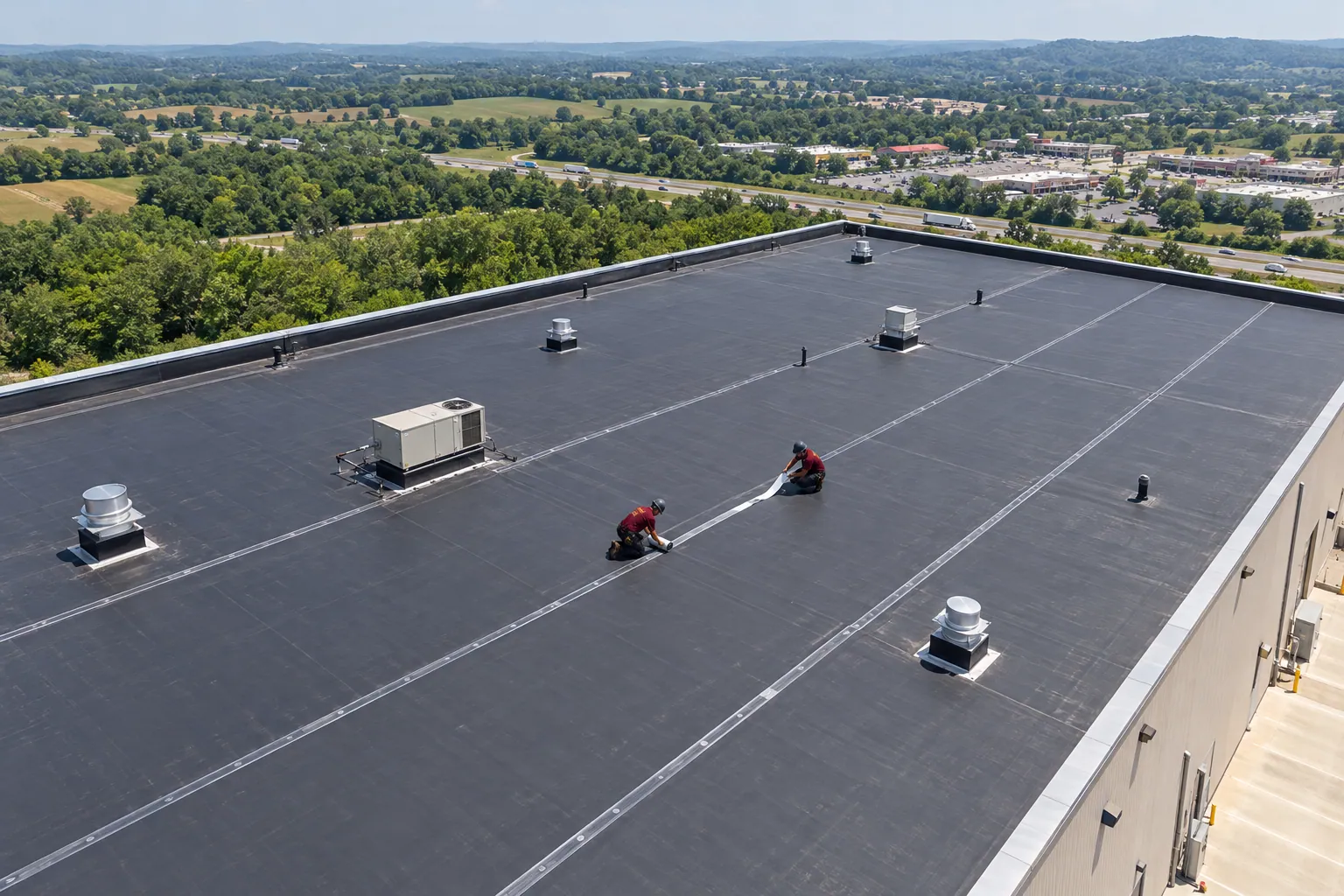
Pre-formed TPO curb wraps and welded corners make each unit's flashing part of the membrane.
TPO roofing
Plant roofs with heavy units on steel frames need high-density cover boards and planned lifts.
Industrial roofing
Cracked curb flashing and leaking pitch pans can be fixed one unit at a time between replacements.
Commercial roof repairCall and tell us which unit sits over the stain, and the roof walk starts at that curb.
Six steps keep the roofing and the mechanical work in the right order.
We walk every curb, duct, fan, and penetration, measure curb heights against the planned roof thickness, and check the deck from inside under each unit.
Your mechanical contractor is scheduled for disconnects, and crane or lift days are set for units that have to come off their curbs.
Inside Lebanon, the city's building inspector reviews the roof replacement; for an address past the city line, jurisdiction is checked with the state housing department.
Units come off, curbs are raised for the new insulation, and each one gets new flashing before the unit goes back.
Mechanical contractors reconnect the units, walkway pads go down on each service path, and every curb is photographed.
After the units are back and the first heavy rain passes, the curbs and new flashing get a walk to confirm they shed water before the job is closed out.
Building out past Lebanon? call us or send us a message. Our commercial roofing area takes in Elizabethtown and each town listed below.
Home base, with city plan review for reroofing.
Elizabethtown commercial roofingStorefront rows and Grayson County permits.
Leitchfield commercial roofingChurch and school roofs, LaRue County permits.
Hodgenville commercial roofingSeason-by-season scheduling, Hart County permits.
Munfordville commercial roofingHistoric district roofs, Nelson County permits.
Bardstown commercial roofingDrains and scuppers, city inspector review.
Springfield commercial roofingAnswers about curbs, units, and permits during a reroof.
Inside Lebanon, the city's building inspector does, the local office on the state's Marion County sheet. For an address past the city line, check with the Kentucky Department of Housing, Buildings and Construction about who has jurisdiction. Give the inspector checkable details: tear-off or recover, insulation, edge metal and gutters, and any units lifted for curb changes.
Often, yes. New insulation set to the energy code raises the roof surface, and a curb that was already short leaves too little flashing height. Units are lifted, curbs are extended, and the flashing is rebuilt to the right height above the finished roof.
Vibration, sun, and roof movement crack curb flashing at the corners, and a curb too short for the roof lets water over the top. Pitch pans around ducts and gas lines shrink as their filler dries. The fix is new flashing at the right height, with reinforced corners.
A licensed mechanical contractor, scheduled around the roofing crew. They disconnect units before lifting, then reconnect and test them after the curbs are raised and flashed. The roofing schedule is built around those visits so cooling and heating come back as planned.
The city inspector handles it inside Lebanon, and outside the city the state housing department confirms who has jurisdiction. Either way, bring the tear-off or recover plan, insulation type and thickness, new edge metal and gutters, and the list of units being lifted, along with membrane or panel data sheets.
They should have them. Technicians walk the same path on every service call, and without pads the membrane wears or gets punctured by dropped screws. Pads run from the hatch or ladder to each unit so traffic stays off the open field.
Start with a roof walk that measures every curb, and the mechanical schedule follows from there.
Leave a name and number, or call (930) 201-3950 now.